Checked luggage is where trips go to be delayed: bags miss connections, carousels swallow forty minutes, and fees quietly double the ticket price. Carry-on travel fixes all of it — you land and walk straight out the door — but only if the bag is packed with a system. This checklist is that system: what goes in, what stays out, and the technique that fits a week of life into a bag that fits the overhead bin. It works for the two-day work trip and the two-week holiday equally, because the method scales by repetition, not by volume.
Before the lists, the golden rule that makes everything else work: pack for five days regardless of trip length, and plan one laundry stop for anything longer. Travellers who pack fourteen outfits carry fourteen kilos of regret. Travellers who pack five and wash once move through airports like they own the place — and our guide to how flights actually work explains why every kilo you skip also trims the fare.
Documents and money: the non-negotiables
Passport or national ID, boarding pass in the airline app with a screenshot backup, and one physical payment card plus one backup stored separately in the bag. Add travel insurance details saved offline, a photo of every document stored encrypted on your phone, and if you drive at the destination, the licence. One small notebook with key addresses and booking codes survives every battery failure — the old technology remains the most reliable one.
Distribute before you leave: primary card in your wallet, backup card in the luggage inner pocket, some cash split between both. The single-wallet traveller who loses that wallet loses the trip; the distributed traveller loses an afternoon. Two minutes of distribution buys the whole holiday back.
Tech: the modern survival kit
Phone, charger and a cable for each device you carry — pack chargers in your personal item, not the rolling bag, because airlines occasionally gate-check the roller at the last minute. Noise-cancelling or plain headphones turn any cabin seat into a study, and a power bank under ten thousand milliamp-hours is universally allowed on board. A universal adapter for international trips, a short charging cable for airport pillars, and your e-reader complete the kit. Everything else — tablets, laptops, second cameras — is negotiable, and each item you skip is one less thing to defend at security.
One underused trick: photograph the contents of your bag with your phone before closing it. If the bag is ever stolen or lost, that photo turns a painful insurance claim into a two-minute form. Repeat it before every flight.
Clothing: the 5-4-3-2-1 formula
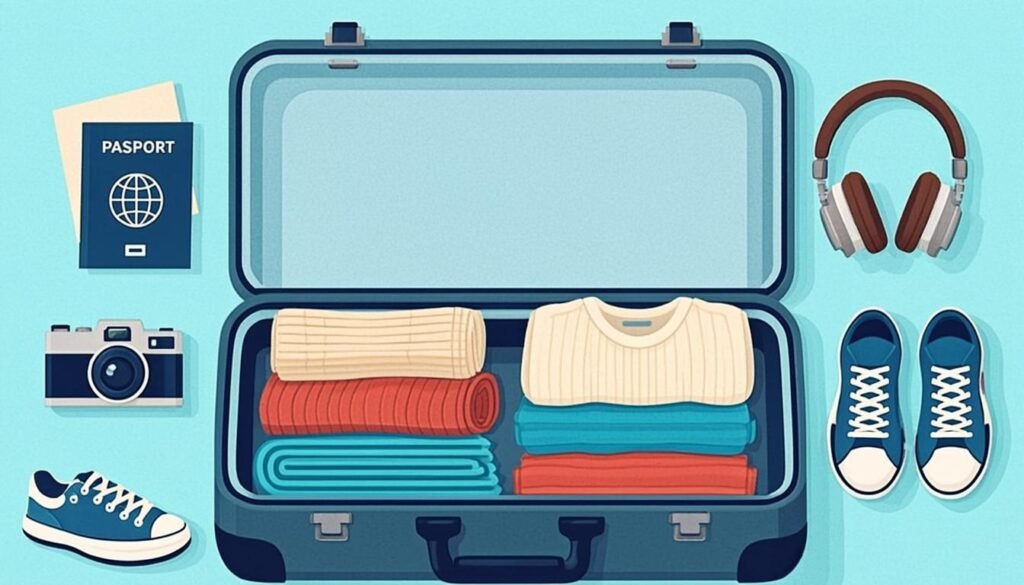
The formula that fits any week: five sets of underwear and socks, four tops, three bottoms, two pairs of shoes, one outer layer. The magic is in the mixing — four tops and three bottoms make twelve outfits, and a jacket in a neutral colour unifies all of them. Choose a two or three-colour palette per trip so everything combines; the darkest, heaviest pair of shoes travels on your feet, and the sneakers wear their second day with fresh socks. Roll everything except jackets — rolling compresses and prevents creases, while structured jackets keep their shape folded over the top of the pile.
Fabric choice multiplies the formula: merino wool and modern synthetics resist odour for days, which is how one shirt legitimately serves three evenings. Cotton denims are the enemy of light travel — heavy, slow to dry, and needed rarely. If the trip includes one smart dinner, one dark outfit that works with either pair of shoes covers it.
Toiletries within the liquid rules
Security liquid limits mean each container holds one hundred millilitres or less, all fitting inside a single clear litre bag. The efficient answer is not tiny travel bottles of everything — it is solid versions of everything: shampoo and soap bars, solid deodorant, toothpaste tablets, sunscreen sticks. Solids skip the liquid bag entirely, never leak, and last for months of trips. Add a toothbrush, razor, medications in original packaging with prescriptions for anything controlled, glasses or contact lens supplies, and a minimal first-aid pouch: plasters, painkillers, motion sickness tablets, rehydration sachets.
The litre bag lives in the outermost pocket of the personal item, not buried in the roller, because at security you want it out in five seconds. Anything you buy at the destination — large sunscreen, full-size toiletries — gets left behind at the end of the trip rather than haunted home.
The personal item: pack like it matters
The under-seat bag is not an afterthought; it is your survival kit for the flight and your insurance against the roller being gate-checked. Into it go: passport and wallet, all electronics and chargers, medications, the liquid bag, one change of underwear and a t-shirt, snacks, a refillable empty water bottle through security and filled after, and anything irreplaceable. If the roller travels without you, the trip continues unaffected — that is the entire philosophy of the system in one bag.
What stays home
The cut list saves more space than the pack list fills: more than two books (the e-reader replaced them), full-size anything, hairdryers (every accommodation owns one), more shoes than two pairs, umbrellas that fold badly, and the what-if outfits for scenarios that never happen. The honest test for every borderline item: would I buy this at the destination if I needed it? If yes, leave it — almost everything is purchasable almost everywhere, which is the quiet miracle of modern travel.
Frequently asked questions
What size bag counts as carry-on?
Most full-service airlines accept around 55 by 35 by 25 centimetres for the roller plus a personal item under the seat, but low-cost carriers enforce smaller limits and stricter gauges. Check your specific airline before buying a bag, not after, and measure your current bag once — many travellers discover their ‘carry-on’ is actually regional-check-in size. A soft-sided bag within the most common limit squeezes into stricter frames when needed.
How do you fit two weeks in a carry-on?
The same five-day wardrobe plus two laundry stops: a sink wash with a travel detergent bar for underwear and shirts, or one laundromat visit per week, which is a pleasant hour anywhere in the world. Fast-drying fabrics make the system work — washed on Monday evening, worn on Wednesday. Two weeks in one bag is genuinely comfortable once you trust the repetition.
Is a personal item really free on airlines?
On most full-service airlines yes, and on low-cost carriers it is the only free allowance — which is why the whole strategy fits the trip into that under-seat bag. Measure against the airline’s stated personal item dimensions, typically around 40 by 30 by 20 centimetres, and choose a soft backpack rather than a rigid case, because soft bags look like purses at the gate and rigid bags look like targets.
What should never go in checked luggage?
Everything irreplaceable and everything essential to the first twenty-four hours: documents, medications, electronics, one clothing change, jewellery and chargers. Checked bags travel through a system you do not control, and the statistic that matters is simple — a small percentage of bags arrive late or lost every year. The carry-on philosophy removes that statistic from your trip entirely.
Print this checklist or save it to your phone, run it once exactly as written, and then adapt it to your own habits — the framework holds while the details personalise. Pack the night before, weigh the bag on the bathroom scale once out of curiosity, and walk onto your next flight carrying everything you need and nothing you do not.